

A fair contract and a little respect: Not too much to ask for working the nation’s toughest beat in an environment where violent outbreaks are a sure bet.
By Ian Pickett, C.O., California Correctional Institution, Tehachapi
This article is reprinted with permission from Peacekeeper, a publication of the California Correctional Peace Officers Association
At Calipatria State Prison near El Centro, California, Aug. 18, 2005, started out like any other day. Just routine duties, until a correctional officer noticed an inmate concealing something suspicious inside his clothing. The officer approached the inmate and ordered him to submit to a clothed body search.
As soon as the officer started the pat down, he realized the inmate was concealing an inmate-manufactured weapon. When the officer grabbed onto the weapon, the inmate began to struggle. Fearing for his safety, the officer forced the inmate to the ground. As soon as they landed on the ground, 10-12 inmates immediately ran to and attacked that officer, repeatedly stabbing, slashing, and kicking the officer in the head and upper body. As other staff responded to the incident they, too, were attacked by inmates.
When I arrived on the scene I saw that assaulted officer. It was my closest friend, a very dedicated officer who taught me so much. Officer G. Harbert had been viciously assaulted and was walking off the yard under his own power. I could hardly see his eyes and he was literally covered in his own blood.
Less than five minutes later, as I went to help secure the yard and other inmates, I heard yelling behind me. When I turned around, I saw officers being attacked by inmates in front of our dining hall. The female dining officer had been chased throughout the dining hall and was subsequently attacked as she made her exit out front.
I sprinted to that area in an effort to assist the officers under siege. As I got closer, I was yelling for the inmates to get down but they continued their savage attack on my partners. I grabbed onto one inmate and tackled him to the ground where he and I struggled. He bit my hand and continued to fight until finally I was able to gain control of him. My other partners fought with and gained control of the other assailants.
Less than two minutes later, I walked back out onto the yard in an effort to again start securing the yard. Almost immediately, the audible alarm on housing unit Charlie 5 began to sound. I responded to the alarm. As I entered the building, I saw a captain completely enveloped by at least six inmates who were assaulting him. All in all, there were 25-30 inmates waiting for us in ambush inside that building with a mixture of weapons ranging from mop handles to knives. I ran directly to the captain and engaged the inmates attacking him. Together, we did our best to defend ourselves from the attempt being made on our lives.

Meanwhile, the bravest people I have ever worked with continued to defend themselves against the rest of the inmates. With nearly 30 of them and only six officers, it was at that moment that I really did not believe I would make it out of that building alive that day.
We continued to fight for our lives to the best of our abilities for what seemed like a lifetime until a gunner, who saw an officer about to be seriously or fatally stabbed, pulled the trigger on a mini-14 rifle, killing an attacking inmate and effectively ending the riot.
The three incidents had gone on for close to an hour.
Some of my partners had come close to death. I suffered injuries to my back, including bulged discs, nerve damage, and lacerations to my face. All of us were happy to be alive, yet shocked to have survived. Not one of us could take more credit than the next. We had fought and won for each other, together.
The next morning I was back at work answering the questions from the Office of Internal Affairs about the shooting death of the inmate. I guess they were there to find out if we had defended our lives in an ethical manner.
The day after that I returned to work, full duty, as did many of the victims of the assault that day. The ones who didn’t return soon would. They were only waiting for their wounds to heal. They are, in fact, the definition of bravery and an inspiration to me — as they should be to you.
The following year, on Dec. 19, 2006, I found myself on an upper tier telling an inmate to stop so I could perform a clothed body search, as I suspected he had something in his pocket. The inmate refused my instructions to stop and take his hands out of his pocket. Instead, he charged me, swinging wildly, eventually stabbing me in the neck with an inmate-manufactured knife. As my partner came to my aid, he was attacked by another inmate.
After that assault, I had the first real argument with my fiancé. She was livid that I had tried to return to work the day after being assaulted. In the end, I was told I could not return until the stitches and staples were taken out of my neck. The day they were removed I returned to work on full duty.
Also in 2006, my friend and partner, Officer Malcomb, was nearly killed when an inmate walked up behind him and slashed his throat with a razor. Officer Malcomb was able to fend off his attacker and survived by only millimeters, as the weapon just missed vital arteries. I stood by at the staff entrance that very night and witnessed Officer Malcomb trying to return to work only hours later, with more than 20 stitches in his throat and neck. Like me, he, too, was turned away due to the rules. He is now back at work.
The inmates in both the 2005 and 2006 incidents I’ve described here were acting on their own prison codes. Specifically, if you are caught with a weapon you must try and use it on the staff member who catches you with it. And, if one of their fellow inmates or homies gets involved in a physical altercation with a staff member, it is the duty of all the affiliated inmates to also attack.
In 2004, yard officers on B Facility were simultaneously attacked by Crips inmates in front of Housing Unit B4. One staff member lost consciousness and was nearly choked to death, while another officer trying to help him was hit over the head with a baton an inmate had taken from a fallen officer. Both officers are at work today.
In 2001, another of my partners — an officer I have learned a great deal from — was faced with a split-second decision. During the search of the yard after an inmate-on-inmate stabbing, the staff on the yard found an inmate with a weapon. Almost immediately, the entire Hispanic population on the yard at that time, upwards of 90 inmates, began to attack all staff.
During the fight, my friend witnessed a female officer about to be hit by an inmate who had armed himself with a baton taken from a fallen officer. My friend made the decision to jump in between the attacking inmate and the female officer. He was hit across the head and face. To this day, he continues to suffer from headaches so bad that at one point he suffered such a loss of balance that he fell and broke his wrist. Today, he is also back at work.
All of the assaults I’ve detailed here occurred at Calipatria State Prison, a 270-designed, Level IV, maximum-security prison. Yet, these are only a few of the many violent assaults and incidents that have occurred there. You would simply get tired of reading if I listed them all.
Unfortunately, I do not have the gruesome details readily available in front of me to show the numbers and severity of staff assaults that occur at all prisons, across the state, every day. I do know there is an average of nine inmate assaults on officers every day in California prisons. All staff members I have referred to here-and many more- have been viciously assaulted during attempts on their lives and bear scars to this day. Every officer I mentioned has returned to work and continues to work at this writing. The sad fact is that they continue to do their jobs without any fair contract offered to them by the state of California.
|
| (AP Photo/ Jim McKnight) |
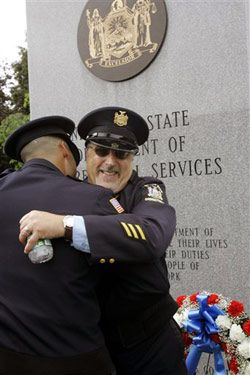
These brave people offer up their lives every day, not knowing if they will make it home to see their families at the end of their shifts. These officers-my partners, brothers and sisters-give their best every day, yet the state can only offer what they call its Last, Best, and Final offer. We all know that we are not being offered the state’s best in return for ours.
The California Highway Patrol has received a fair contract, as they should. Currently, their salary is about that of a correctional lieutenant. I recognize the high danger CHP officers place themselves in every day, and they are one part of a very honorable profession. I cannot imagine the anxiety and fear that officers on the streets face every time they walk up to a car on a traffic stop, not knowing if the person they are about to face is a criminal willing to take a life, or just a gentle, old lady who forgot to signal.
On the other hand, our officers are faced with a very different scenario, one that also offers anxiety and fear. But with us, every time we approach someone inside the walls of a state penitentiary, we know, without a doubt, that this person is a convicted, often violent, felon, most of whom would like nothing more than to watch us lay on the yard and bleed to death at the hands of an inmate. And if you think the inmates are always unarmed, you haven’t been paying attention.
On Sept. 11, 2001, our country was attacked and many brave men and women of the New York City Fire Department and Police Department gave their lives in the line of duty.
Unfortunately, we live in a society that requires a mass loss of life in tragic circumstances in order to recognize the need for the services of such brave men and women. I’m sure that after September 11, neither of those Departments has had a problem negotiating a fair contract with the state of New York.
In no way am I trying to take away from the sacrifice and dedication shown by the men and women who made the ultimate sacrifice in New York that day. However, I wonder if the state of California and the Department of Corrections and Rehabilitation will continue to be such a reactionary system that it will take the murder of hundreds of correctional officers before we, too, are shown respect and treated fairly.
Every corrections employee walks into their facilities to begin their shifts with the thought in the back of their heads that they may not walk out. And to make that conscious decision to walk through those gates anyway, we, along with other law enforcement personnel, surely deserve the same respect, fairness, and rights shared equally throughout the profession.
We are not asking for a monument, no highways named after us, no medals. We are not asking the politicians to defend us against the unrelenting, unwarranted attacks from politicians and the media.. We are just asking for a fair contract, one that is equal to that offered other state workers who daily put their own safety on the line to protect others.
We should get paid for what could happen but thankfully not always does.
I would like to extend an invitation to every politician to come work with us for just one day. Sign your post orders, put our belt and boots on, shed your bodyguards and your titles, and depend on your partners only to get you safely through the day.
And when your shift is done, let me know if you would do our job, at any time, for a penny less than what we ask for — and deserve.
About the author
