

By Greg Garland
The Advocate
(AP photo) |
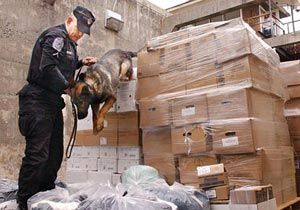
ANGOLA, La. — The walls of Lt. Joseph Russell’s security office at Louisiana State Penitentiary are covered with dozens of snapshots of illegal drugs, homemade knives and other prohibited items corrections officers have found on inmates, visitors and staff at the sprawling prison.
The photos starkly illustrate a problem that prisons across the nation face— keeping contraband out and finding prohibited items that inmates try to hide from the correctional staff.
Prison experts say it is impossible to keep out all contraband, despite the best efforts of prison administrators and security staff.
Louisiana, which implemented extensive court-ordered prison reforms in the 1970s and 1980s, does a better job than most, said Jim Gondles, executive director of the American Correctional Association.
“Angola is a picture-perfect example of how their system has turned around,” Gondles said.
Angola had a fearsome reputation as the bloodiest prison in America before the federal courts intervened to force changes in how that prison and others were managed.
Gondles noted that Louisiana is one of only 14 states whose prisons are fully accredited by the corrections association.
The state has just under 20,000 inmates in 11 state-run and two privately managed prisons. To achieve accreditation, prisons must show they adhere to national standards set by corrections experts, he said.
But even well-run prisons confront problems with contraband.
“It’s like fishing, you can’t catch them all,” Angola Warden Burl Cain said.
According to statistics compiled by the Louisiana Department of Public Safety and Corrections, illegal drugs were found inside state prisons on 1,265 occasions from 2006 to 2008.
During the same three-year period, urinalysis tests conducted on inmates registered positive for drugs 1,402 times.
The prison system conducts more than 40,000 such tests each year, records show.
He said that helped attract better job candidates, less prone to being corrupted. It also improved retention rates.
“What hurt us was when the pay was so low that we’d hire anybody who could walk and chew gum at the same time,” Cain said.
“Most of this is gone now.”
Travis, chief of operations, said inmates will seek to turn a corrections officer by paying him to bring in small creature comforts — such as a pack of gum that isn’t available from the prison commissary or a McDonald’s hamburger.
If an officer falls into that trap, he can be blackmailed later into bringing in drugs or other contraband, Travis said.
Rader said the small amount of drugs and contraband that gets into Louisiana’s prisons appears to come in mostly through inmates on outside work details.
“I think less comes in through visitation and more comes in through offenders or employees smuggling it in,” Rader said.
Most are random, but others are conducted based on “reasonable suspicion” — which means an inmate’s behavior suggests he might be using drugs.
The majority that turned up positive — 1,167 — registered for THC, the chemical substance found in marijuana. But there also were 71 positives for cocaine, 30 for amphetamines
and 119 for other drugs, according to data compiled by prison officials.
Jeff Travis, chief of operations for the corrections department, said drugs find their way into Louisiana’s prisons a variety of ways.
For example, he said, an accomplice from the outside might tape a packet of drugs to the back of a street sign for an inmate on a work crew to retrieve, or leave drugs in an empty soda can along the highway.
“When you’ve got a bunch of inmates trying to beat you,a little bit gets by you sometimes,” Travis said.
And the inmates can be inventive.
In one case, an inmate had a friend tape some marijuana to a paper airplane and sail it across a double security fence and onto prison grounds, said Steve Rader, warden of Dixon Correctional Institute in Jackson.
“There’s a lot of guys that like to smoke marijuana and will pay whatever they have to pay to get it in,” Rader said.
Drug-sniffing dogs, cell and dormitory shakedowns and inmate strip-searches are among the measures employed to keep contraband out of the prisons. So is sophisticated technology, such as ion scans that can detect the slightest trace of drugs, he said.
“Even in the most high-tech, high-security prisons in the country, contraband still gets in,” said Rader, a 30-year veteran of Louisiana’s correctional system.
He added, “We do shakedowns continuously and we still find stuff, although not as much as some systems find.”
Corrupt staff provide one avenue for drugs, cell phones and other contraband to get into prisons, corrections officials concede.
Cain, the warden at Angola, said that was more of a problem before pay for corrections officers was raised.
The front gate security at a prison is set up to make it difficult for visitors to slip drugs to an inmate. Their cars are subject to search and dogs are taken routinely through parking lots to sniff for the presence of drugs.
At Angola, a maximumsecurity prison, an arriving visitor enters an enclosure resembling a telephone booth.
A fan mounted above blows air down over him. A drugsniffing dog on the other side of the wall scratches a screen if it smells drugs.
Corrections officials say drugs and other contraband in prisons often fuel inmate violence as they fight for control of the illicit market.
“It parallels what you see on the streets if you don’t stay on top of it,” Travis said.
The consequences at Angola can be severe for an inmate caught with drugs or committing an act of violence against another prisoner.
Most of Angola’s 5,200 inmates live in dorms, work in the fields or at other prison jobs and have limited freedom within the prison grounds.
But inmates who don’t follow the prison’s rules can be sent to cell blocks. The most dangerous and disruptive inmates go to Camp J, where they stay locked in cells 23 hours a day, Cain said.
“They don’t want to be there,” Cain said.
He said inmates regularly tip him off to the presence of drugs or knives because they don’t want drugs or the violence that accompanies the drug trade inside the prison.
“If you get caught with a knife or trying to kill another inmate, we’re going to lock you up because you’re a predator,” Cain said.
He said the inmates, by their actions and behavior, choose whether they want to live decently in a dorm or in a bleak cell.
An inmate housed at Camp J is allowed “no television, no reading except the Bible and
gets one hour a day to walk up and down the tier,” Cain said.
Camp J inmates also are allowed just one hour of yard time, three times a week, “if the weather’s good,” Cain said.
The system appears to work. Few drugs are getting into Angola, and inmate-oninmate violence stays at low levels, according to corrections department data.
Statistics compiled by prison officials show just 13 inmates suffered “significant injury” as a result of inmateon-inmate assaults from 2006 through 2008.
A significant injury is defined as one requiring urgent and immediate treatment and which restricts an inmate’s usual activities for six weeks or more, Travis said.
Most who are familiar with the evolution of Louisiana’s prison system over the years credit the federal courts with forcing reforms at Angola and Louisiana’s other prisons.
“The federal intervention was critical,” said Ross Maggio, warden at Angola in the mid-1970s. “If it hadn’t been for federal intervention, my hands would have been tied.”
Once federal authorities took over, the state was forced to make money available to hire more correctional officers and to pay for other measures to stop the drug trafficking and rampant violence, said Maggio. He later became a court-appointed expert and helped shepherd through many of the reforms still in place at Angola and other Louisiana prisons.
Maggio said building and opening Camp J and other cell blocks to lock away inmates who are disciplinary problems was a critical step in turning around Angola and getting the prison back under the control of administrators.
“Angola has been called the safest maximum-security prison in the country, and I think that’s with a lot of justification,” Maggio said. “It’s come a long way.”
Copyright 2009 Capital City Press