

Op-Ed by Patrick Leddy
Calif. budget plan would cut prison time, loosen parole rules
Gov. Schwarzenegger recently announced his plans to have the California prison system release up to 30,000 inmates prior to their parole eligibility dates, without any parole supervision.
I’ve got a question for the Gov: “How many CHiPS officers are you gonna lay off?”
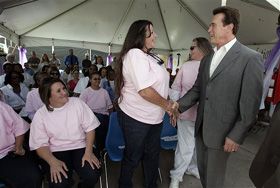 California Governor Arnold Schwarzenegger greets inmates at the California Institution for Women in Chino, Calif., March 6, 2008.(AP/The Press-Enterprise, Silvia Flores, POOL) |
The reason I ask is that is, well. . .this has been tried before, folks. It’s been done in Illinois, from 1991 to 2000 — all but the “early release” part. Arnold should have someone ask the Illinois Sherrif’s Association how fun that was.
A good friend of mine, Dave Struckoff, Executive Director of the Justice Research Institute agrees with me. The JRI is headquartered in Joliet, Illinois. Dr. Struckoff is pretty well respected in the Criminal Justice practitioner and academic community around, not just our country, but the world.
When I asked Dave what he thought about the California plan, Dave said, “It didn’t work here, and it won’t work in California.”
Those of us who believe it won’t work have seen the monetary damages a policy of early release inflicts on the community.
As a former Illinois parole officer, my primary job responsibility was making sure the parolee was obeying the law, and beyond that, complying with what we called “special board orders,” which usually addressed the Illinois Sentencing Review Board’s concerns regarding treatment for sexual predation, violence, alcohol and drugs. The Federal Parole Commission did the same thing prior to parole’s abolition at the federal level. Now, judges can amend the conditions of federal probation based on the same factors parole boards use.
I believe the fallout to California, economically and criminally speaking, will be devastating if the governor gets his way. I also shudder to think of the possibilities for retaliation aimed at crime victims, who often will contact supervising parole agents with tips. (I have experienced this myself, and the tipsters were not lying.)
In the wonderful world of public administration, government policies often have unintended consequences. Without the use of charts, graphs and Powerpoint presentations, I can tell you readers that post-incarceration monitoring via a robust parole system is crucial for the community in many different ways. Maybe even Jerry Brown gets it! If no one in California understands this (and I know folks who do), the consequences are dire.
Robust parole supervision prevents crime.
About the author
Patrick Leddy, B.A. English, M.S. Criminal/Social Justice Admin, is a seventeen year veteran of the Illinois Dept. of Corrections and the Federal Prison System. He also has worked in the Private Security Industry as a bank facility security director, and has taught college criminal justice courses as well as consulted in correctional tort cases. Mr. Leddy has also worked as a consultant for the Chicago Dept of Aviation and successfully wrote and defended a successful grant application for a major security upgrade for Chicago’s Midway Airport during a major reconstruction project. His most recent consulting project was a top to bottom design project for a sex-offender facility in Illinois regarding an emergency fire evacuation project. He instructed newly hired security staff after the design was approved. Mr. Leddy is a self-admitted stickler for clear, concise, written policy at all levels of the public sector in the correctional field.