

By Joe Auricchio, CHFM
The Critical Care Hospital (CCH) at the Virginia Commonwealth University Health System was opened in October 2008 and houses intensive and progressive care units for patients who are critically ill or injured.
Eleven of the 15 floors contain ICU and step-down rooms of many medical disciplines. One of the unique floors in this building is the Security Care Unit which admits patients from the Virginia Correctional Facilities. This 20 bed, in-patient unit provides acute and progressive care for more than 23 Medical/Surgical services.
The unit operates 24/7 with Virginia Department of Corrections (DOC) officers on duty and present in the unit at all times. The area also has 4 exam rooms and a procedure room for offenders who need outpatient specialty care in a secure environment.
Services, staff, and security all expanded when this unit opened. The unit was formerly located in West Hospital and averaged only 6 inpatients that had only general care needs. Medical services available to these patients almost tripled. The hospital and DOC personnel partner together to facilitate the daily care and transportation of the patients in and out of the hospital.
The one thing that has remained constant is the unique ways patient prisoners hide contraband items.
Since opening, the DOC and nursing staff have regularly found needles, medications, and other potentially dangerous items hidden around the inpatient rooms. Despite regular shakedowns at shift change and observant nurses and officers, items were still being found by the staff.
After a plant operations employee was stuck with a needle hidden under a sink, we realized we had to step up our defenses. A collaborative effort was initiated by the leadership of plant operations, nursing, environmental services and the DOC to provide a safer environment by identifying ways to prevent items from being taken and hidden.
The team met and did a thorough assessment of the patient room. From the toilet paper dispenser to the bed side table, everything was assessed. Each party in the group looked at things differently. We all wanted to maintain the functionality of the room and yet make it safer for all at the same time.
Plant operations looked at small spaces and how to engineer ways to prevent accessing them. DOC looked at their shakedown procedures and how to make them more thorough. The nurses looked at controlling medical devices that enter the room. Environmental services reviewed products they provided. The collaborative effort showed great team work in that we all helped each other look at the issue from a different angle and all contributed to the project as a team.
One inpatient room was taken out of service and a number of modifications were made to the room and its contents. After a 60-day trial period, the housekeeping staff, infection control, nurses and DOC officers were asked about the renovations. The feedback was that EVS has not found one hidden item, and the nurses and DOC staff only found items around the bed.
See below for a breakdown per category of the improvements to the inpatient room:
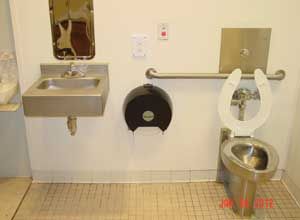
Original bathroom set up.
Lighting: All lighting controls, except at the bedside, were taken out of the room and put in the corridor. This allows the staff to have better visualization into the room from the hallways so that if an offender were trying to “hide” an item it would be detected sooner. It also allows staff to control the lights before entering a dimly lit room at night. All flush mounted lights in the ceiling were covered with lexan covers so patient prisoners could not break the bulb and use them as weapons. Any wall fixture that had a horizontal surface was given a stainless steel cover made at 45 degree angle to prevent anything being hidden on the top.
Television: The DOC staff commented that one means of controlling patient prisoner behavior was to control the TV. The previous way was to enter the room and exchange the pillow speaker out for a new one that only called the nurse station and had no TV functions. We installed a toggle switch in the corridor that controls power to the outlet the TV is plugged into.

Now if a patient prisoner gets rowdy, The DOC staff does not have to enter the room to turn off the TV. The TV was also encased in a stainless steel case with a lexan viewing area to prevent access to the power and antenna cords. The case was mounted tight against the ceiling and the wall behind so nothing could be hidden on top of it or nothing could hang from it.
Bedside table: The over the bed table stayed but the bedside table had to go. It had three small drawers and consumed a large amount of time during shakedowns because of all the small hiding spaces within the furniture. We removed the bedside table and installed 2 sets of open shelves. The one piece shelves are constructed from 3/16” steel. They were neatly finished with a powder coating paint.
Night lights: The original night lights had a thin cover made of aluminum that was not well secured to the wall and could easily be removed and used as a weapon. The night lights were replaced by a ceiling mounted high hat positioned over the bathroom area. This light stays on 24 hours a day and serves as a night light and egress light to meet code requirements.
Toilet paper and paper towel dispensers: A common hiding spot was inside the paper towel and toilet paper dispensers. Both were made from dark brown plastic which was hard to see into and easy to break into small pieces. We designed and fabricated a simple soap and paper towel holder out of clear lexan.

The toilet paper holder is now a curved piece of powder coated steel that resembles a J. These changes put these objects in plain sight and gave the DOC personnel a better view during shakedowns and lessened the amount of time for the inspection.
Sinks: The needle stick happened when an employee reached under a wall hung stainless steel sink to do a repair. We designed and fabricated a stainless steel cover that fits underneath the sink and is fastened to the wall and the sink. The cover eliminates patient prisoner access to the area under the sink and reduces hiding spots. It also provides additional support for the wall hung sink if a patient elects to sit on it.

Shower curtain: The original shower curtain only revealed the patient prisoner’s feet while in the shower. The new curtain shows their feet and from the chest up so the staff have a clear view of what the person is doing while still maintaining privacy.
Wall clock: The clock was taken out of the room and hung on the outside of the corridor window. Patients and staff can easily see the time through the glass. This prevents prisoner patients from taking the batteries or using the clock and/or batteries as a weapon.