

The Missouri National Guard currently prohibits anyone from joining who is ordered to do so. Even if the bill becomes law, implementing it may require a fight.
By Roseann Moring
St. Louis Post-Dispatch
JEFFERSON CITY, Mo. — State Rep. T.D. El-Amin said he likes to find “common sense” solutions.
So El-Amin, D-St. Louis, has proposed one fix for two problems - crowded prisons and an overtaxed military.
|
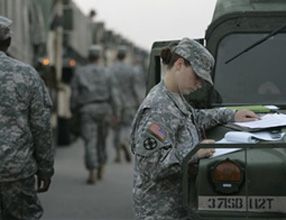 (AP Photo)
He introduced a bill that would allow some nonviolent offenders to serve in the Missouri National Guard rather than go to prison.
“I just think there’s a better usage of those individuals who have committed crimes of a nonviolent nature to get them back on the road of true rehabilitation,” El-Amin said.
But the Missouri National Guard currently prohibits anyone from joining who is ordered to do so. Even if the bill becomes law, implementing it may require a fight.
While only a small percentage of bills filed ever make it to a vote, El-Amin has garnered support from a key Republican, Rep. Mike McGhee, R-Odessa. McGhee, chairman of the House Corrections and Public Institutions Committee, said the eligible offenders would be people who made poor choices, such as writing a bad check.
“We’ve got to start looking at doing things differently,” he said. “We need to do something to eliminate overcrowding and do something to turn some of these inmates ... into givers rather than receivers.”
Under the bill, only first-time offenders who committed nonviolent crimes would be eligible. For example, people convicted of some drug offenses, driving while intoxicated and trespassing could be eligible.
The bill also specifies the offender must serve the full sentence, and the court can revoke the Guard option and send the person back to the Department of Corrections.
“I’m really excited to have legislation that could have an immediate impact,” El-Amin said.
But some question whether the bill proposes an appropriate use of the military.
Cape Girardeau Prosecuting Attorney Morley Swingle, who has taught training sessions to law enforcement organizations in and out of Missouri, said he opposes any measure that would use the military to rehabilitate criminals.
“That’s not, in my mind, the military we want,” he said.
Swingle added that his office does, on rare occasions, choose not to prosecute a person who has already signed up for the military and is accused of a misdemeanor, such as driving under the influence.
McGhee said the military could use the people for positions other than actual combat.
Supporters say the measure could help relieve military personnel of multiple tours of duty. But Capt. Tammy Spicer of the Missouri National Guard said the Guard has met all of its recruiting and retention goals, making this bill a potential solution for a problem she isn’t seeing.
“We’ve got a very talented pool of Missouri National Guard members,” she said.
Spicer added that she had not heard from El-Amin about this bill.
He said he is planning to meet with Gov. Jay Nixon’s appointment for adjutant general, Col. Stephen Danner.
El-Amin said it’s not just about relief for prison, but actual rehabilitation for those being sentenced.
“Opportunities are elusive for these people who are offenders,” he said. “What happens is they’re going to be a drain on taxpayers.”
McGhee added that the measure could help lighten the load on the state budget, which is by all accounts going to be very tight this year.
“I am only trying to figure some way to spend on schools,” he said.
No matter how logical El-Amin and McGhee consider this solution, it might not have a chance of coming to fruition.
Army and Air Force regulations prohibit applicants who have been ordered to enlist. El-Amin said that by using the National Guard, the bill gets around federal regulations.
But Spicer said the Missouri National Guard follows those regulations.
McGhee said even if this particular bill never sees the light of day, he hopes it is a sign of new solutions for the session.
“Maybe it’ll open people’s eyes up to a new direction,” he said.
He added that although he and El-Amin are in different parties, he hopes his fellow Republicans will look at the legislation “on its merit and what it might do for the country.”
Copyright 2009 St. Louis Post-Dispatch, Inc.
What do you think?: Would a National Guard diversion program make a dent in overcrowding, or would the red tape and liability bog the criminal justice system even further? Discuss in the C1 forums