

Corpus Christi Caller-Times
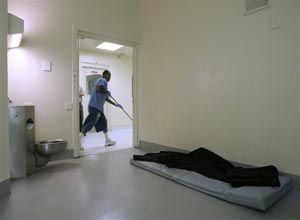
An isolation cell, where inmates are moved if they attempted suicide at California State Prison, Sacramento, in Folsom, Calif. (AP photo) |
NUECES COUNTY, Texas — At first impression, it reads like awful nitpicking. The Texas Commission on Jail Standards cited the Nueces County Jail because jail officers failed to check on suicidal inmates every 15 minutes as required under the jail’s operating plan. The jailers had been called away to other tasks and were said to have missed the mark by between two and five minutes.
“Picky picky,” you think at first, but then . . . if this is a nitpicking technicality, it is a technicality that can mean the difference between life and death. As reporter Dan Kelley outlined last Friday, the citation by the Commission on Jail Standards came only days after the county decided to enter into mediation in a lawsuit with the family of the late Roberto Garcia. His life may have been lost because of a breach of that technicality.
Last year, in August, Garcia’s family called sheriff’s office concerned that Garcia might harm himself in jail. They made arrangements to have the 47-year-old man transferred from the jail and admitted to a mental health facility. Before he could be moved, he strangled himself and was discovered not breathing in his cell. He died three days later.
Sheriff Jim Kaelin said Garcia had threatened to hurt himself when he was arrested and he had a history of attempting suicide. He was placed on the jail’s suicide watch, which requires checks by jail staff every 15 minutes. That wasn’t done. Two employees were charged with falsifying entries on the jail’s 15-minute watch log.
In the latest incidents, the officers were only a few minutes late in making their checks. Sheriff Kaelin said the jail is “minimally staffed” and that under normal conditions there’s adequate staff to perform the suicide watch properly, but there is little margin for error. If something else happens -- a prisoner needing medication or something -- other areas of jail operations feel the pinch.
The Jail Standards citations remind us that, slipups aside, there has been increased public confidence in the operations at the jail under Sheriff Kaelin, who had a difficult inheritance. When he took over two years ago, jail conditions had become so bad that the U.S. Marshal’s office had removed federal prisoners from the facility. The jail’s substandard conditions led to a revenue loss of about $2 million a year to county government. Recently, the County Commissioners Court approved a contract that could return federal prisoners to the jail.
Sheriff Kaelin in his two-plus years has turned the jail situation around. He has instilled a level of professionalism that was needed to improve operations that were costing taxpayers money. The sheriff has done that and the County Commissioners have made decisions to fund long-deferred maintenance and other improvements needed at the jail. But achieving high standards and maintaining them means it will always be a work in progress. This is not an area of county government that should be operating so close to the bone. If the county is going to make money by housing federal prisoners, then part of that money should go back into funding for “minimally staffed” jail operations.
There are safeguards in place to identify the most vulnerable prisoners -- those suffering from severe depression and intense psychological pain -- and a routine that requires a suicide watch be kept on them. But all the safeguards in the world won’t help if there’s not enough manpower to carry out those assignments.
If lack of staffing is an issue -- and it is -- then the County Commissioners should find ways, even in these tough times, to give the sheriff the resources he needs to do the job. The commissioners seem always able to find more money for the Richard M. Borchards Fairgrounds and their own hyper-inflated salaries. As a novel idea the commissioners may not have thought of, why not allocate more money for those county employees who actually work? We’re not just picking on the commissioners, but they do have a track record of making bad decisions when it comes to the allocation of scarce resources.
It may be nitpicking by the Texas Commission on Jail Standards, but having the proper staff levels in the county jail so they can do their jobs matters. Having enough jailers to make that 15-minute-interval suicide watch matters. Ask the family of Roberto Garcia.
Copyright 2009 SCRIPPS Howard Publications